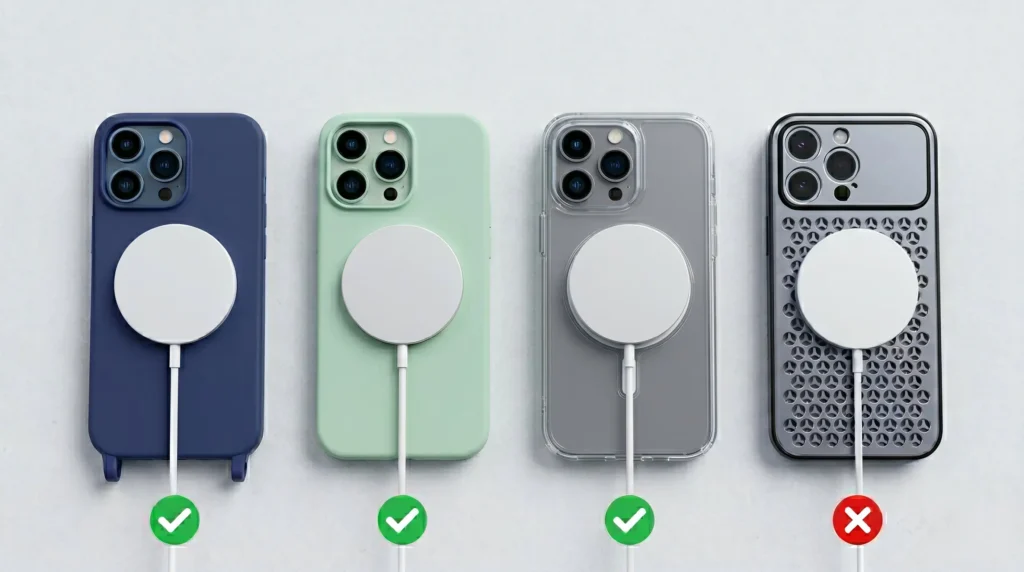
Most phone cases are compatible with wireless charging — as long as they’re non-metal and not too thick. TPU, silicone, and polycarbonate cases all work. Metal cases, very thick, rugged cases, and battery cases don’t.
What Cases Are Compatible with Wireless Charging? (Quick Answer)
Table of Contents
ToggleCases that work:
– TPU cases
– Silicone cases
– Polycarbonate (PC) cases
– Thin hybrid cases (TPU + PC)
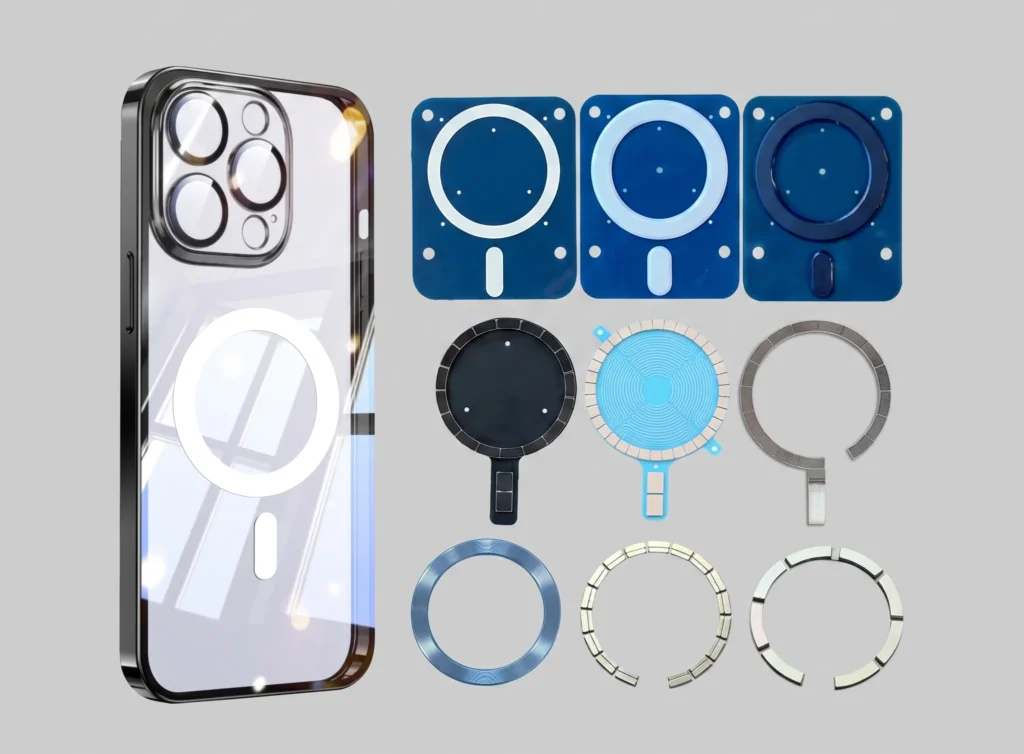
– Properly designed MagSafe compatible cases (with a correct magnet ring)
Cases that don’t work:
– Metal phone cases
– Cases with metal plates, inserts, or kickstands near the charging area
– Very thick rugged cases (4mm+)
– Battery cases
– Cases with poorly designed or misaligned magnets
Does a Phone Case Affect Wireless Charging?
Every case has some effect. Whether it matters depends on four things: material, thickness, internal structure, and magnet placement.
Wireless charging passes a signal through the back of the phone. Anything that blocks or absorbs that signal — metal, excessive thickness, a poorly placed magnet — will reduce charging speed or stop it entirely.
A well-built, wireless-charging-friendly case accounts for all four factors. A poorly designed one fails on at least one.
What Cases Work with Wireless Charging
Wireless Charging Friendly Case Materials
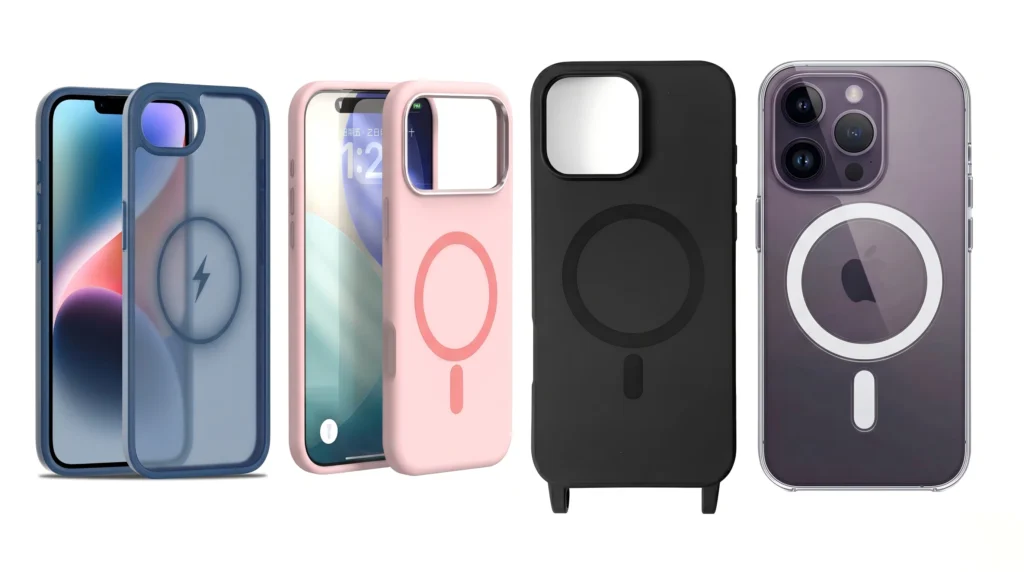
The materials that work share one trait: they let the charging signal pass through without blocking it.
TPU is the most widely used material in wireless charging-compatible phone cases. Flexible, impact-resistant, and fully compatible with Qi and MagSafe chargers.
Silicone behaves similarly. More common in single-material premium cases. No compatibility issues.
Polycarbonate (PC) is a rigid plastic used mostly for back panels in hybrid designs. Fully compatible and pairs naturally with a TPU bumper.
Hybrid TPU + PC cases are safe for wireless charging as long as no conductive elements are added. One of the most popular case structures on the market.
Material choice for TPU, silicone, and polycarbonate wireless charging cases should come down to protection level, and product feel — not charging concerns. All three work reliably.
The Non-Metal Phone Case Rule
Metal blocks the charging signal. Even a small metallic element in the wrong place can cause wireless charging to fail.
It’s not always obvious. Watch for: – Metal kickstands or structural inserts near the coil area – Metallic back panels or decorative plates – “Brushed aluminum” finishes that use real metal film, not a metallic-look coating – RFID-blocking layers placed over the phone’s back
A case that looks identical to a safe design but includes a thin metal shim for rigidity can cause charging failures across an entire production run. This is a real sourcing risk at volume.
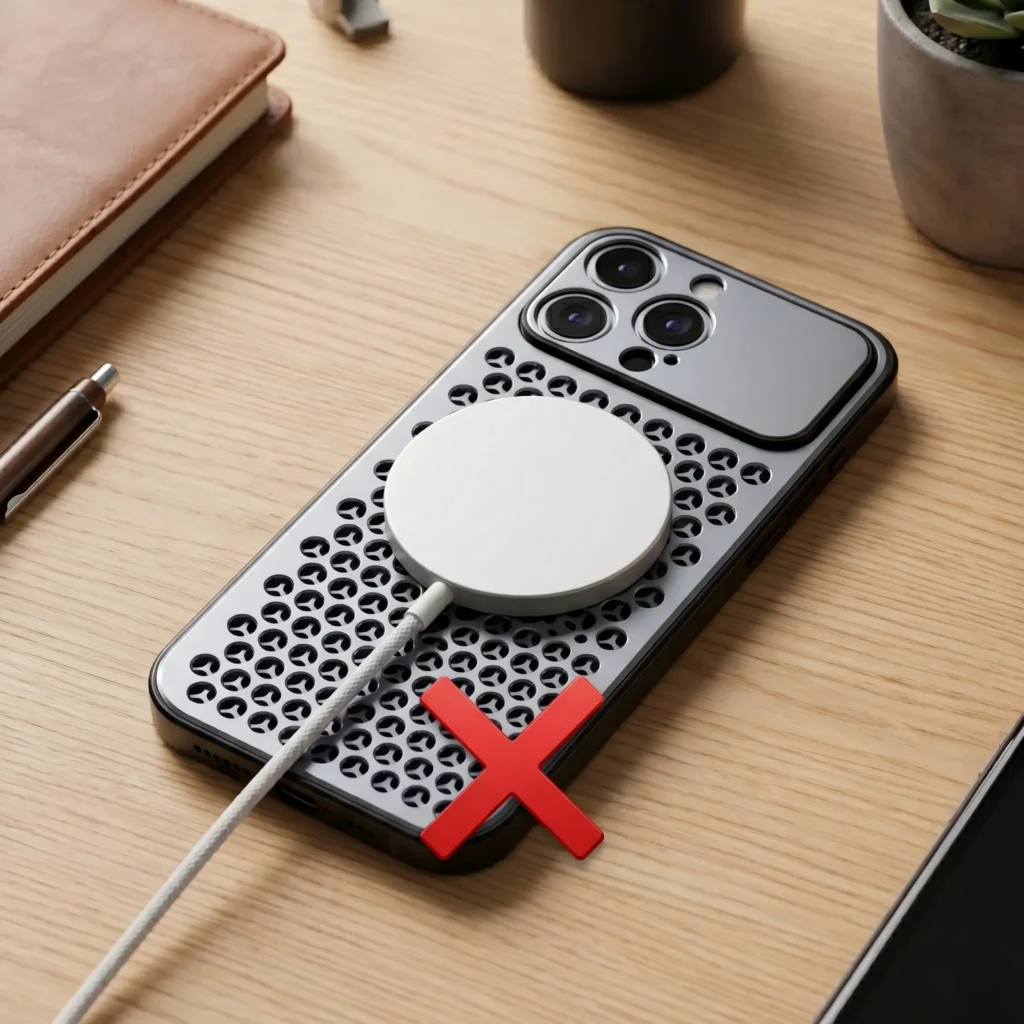
Cases That Interfere with Wireless Charging
Metal Cases
Any significant metal on the case back will block or degrade wireless charging — metallic panels, aluminum layers, or certain carbon fiber composites with a metallic weave. Strong external magnets are a separate problem. Wallet cases with magnetic closures can disrupt both charging and NFC, even when the magnet isn’t directly over the coil.
Thick and Battery Cases
Battery cases don’t work with wireless charging. The built-in battery layer sits between the charging pad and the phone, at 6mm to 10mm thick, so the signal can’t get through reliably.
Rugged cases over 4mm to 5mm see similar issues. The combined thickness of the outer shell, inner liner, and back panel degrades charging performance on most standard Qi pads.
One workaround: recessing the case back over the coil area to reduce effective thickness at the charge point without changing the overall protection level.
Misaligned Magnetic Designs
A case with magnets isn’t automatically a MagSafe-compatible case. If the magnet ring is the wrong diameter, placed off-center, or made from low-grade material, alignment on a MagSafe charger will be weak or inconsistent.
The symptom: the case sometimes snaps to the charger but doesn’t hold firmly, or charges at lower wattage than expected. For buyers, “includes magnets” is not a usable spec.
Case Thickness for Wireless Charging
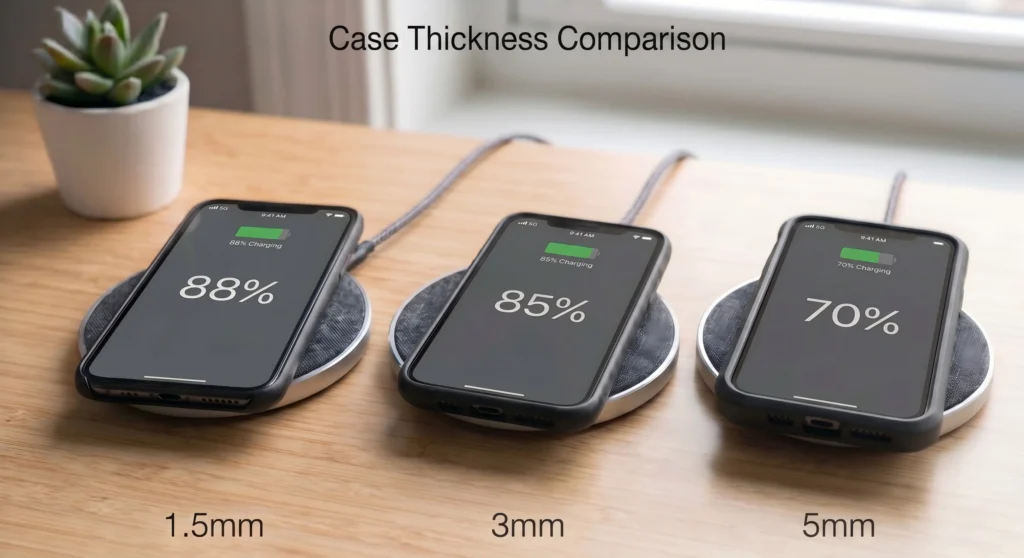
Optimal Thickness Range
Keep the case thickness for wireless charging at or below 3mm for reliable Qi charging. Most standard everyday cases fall between 1.5mm and 2.5mm — comfortably within range.
PC back panels transmit the charging signal slightly better than TPU at the same thickness, but the real-world difference is small for most charger types.
When Thick Cases Start to Fail
At 4mm to 6mm, wireless charging degrades on most standard Qi pads. Heat makes it worse — thick cases trap warmth, which causes the phone to automatically reduce charging speed to protect the battery.
Lab vs Real-World Performance
Lab tests measure charging with the device perfectly centered on a calibrated pad. Real users place phones slightly off-center on a mix of charger brands. Test samples across multiple charger types — including inexpensive aftermarket pads — before approving a design. A case that passes one reference test may still underperform in the field.
MagSafe Compatible Case vs Qi Compatible Phone Case
The Key Difference
A Qi-compatible phone case is passive — it just needs to avoid blocking the signal. No magnets required.
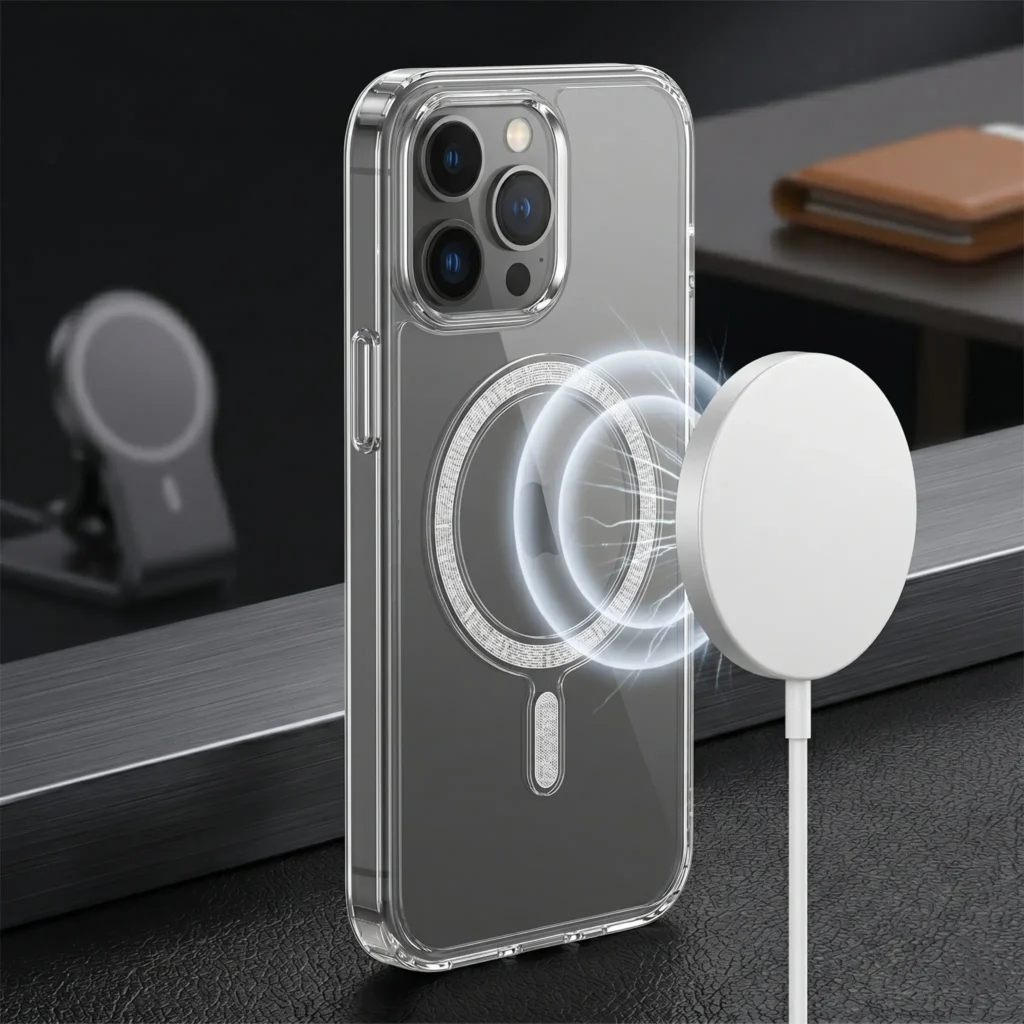
A MagSafe-compatible case is active. It needs a precisely positioned magnet ring that aligns with the iPhone’s internal array to enable snap-on attachment and full 15W charging.
A case marketed as MagSafe compatible without a properly spec’d magnet ring is a standard Qi case. End users notice — the charger won’t lock, or the wattage is lower than expected.
When You Need True MagSafe Compatibility
If your target customers use iPhone 12 or later and are in the MagSafe ecosystem — chargers, wallets, mounts — getting this right is non-negotiable. Cases that deliver reliable snap, full 15W, and accessory compatibility hold their value. Cases that don’t generate returns.
Qi2 Ready Case: What’s Coming
Qi2 brings MagSafe-style magnetic alignment to Android for the first time. Samsung and Google Pixel devices are already moving toward this standard.
For phone case manufacturers, this means the magnet ring spec — previously an iPhone-only concern — is becoming relevant for Android product lines too. Building Qi2 specs into designs now is easier than retrofitting later.
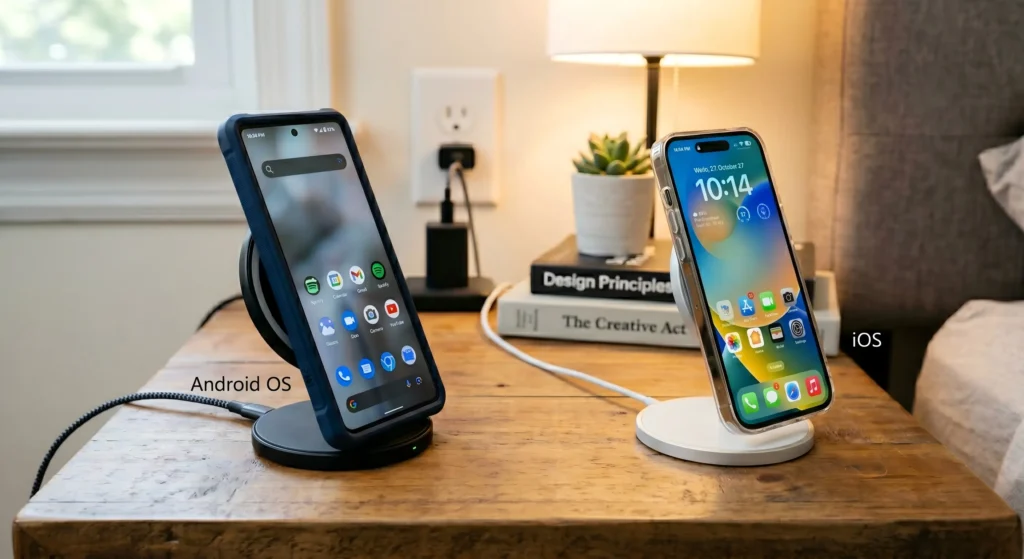
Wireless Charging Case Compatibility for iPhone and Android
iPhone (MagSafe Ecosystem)
iPhone 12 and later support Qi wireless charging out of the box. Any non-metal case within 3mm thickness works for standard Qi charging on these models.
For MagSafe compatibility: the correct magnet ring, correctly placed, at the right grade. That’s what separates a true MagSafe-compatible case from a case that’s just Qi-compatible on an iPhone.
Android Devices (Qi-Based Compatibility)
Most Android mid-range and flagship phones support Qi. Coil position varies — Samsung typically places it near the center-top; Pixel phones are more centered. Confirm coil position by model before finalizing your case design.
Most Android devices don’t have internal alignment magnets outside of Qi2-enabled models. Standard Qi-compatible phone cases for Android don’t need magnet rings unless you’re targeting Qi2 hardware.
Cross-Platform Considerations
Universal phone cases work as basic Qi-compatible cases across many devices. MagSafe product lines targeting iPhone users require model-specific magnet ring placement — that can’t be generalized across platforms. Clarifying this early prevents expensive redesigns after samples are produced.
How to Source Wireless Charging Compatible Phone Cases
Material Specs
Specify TPU hardness in Shore A units. The 75A to 90A range covers most everyday protection cases. Higher hardness is more rigid and transmits the charging signal more consistently. Lower hardness needs thicker walls for structure, which works against the thickness limit.
For PC back panels on transparent cases, optical-grade clarity is worth specifying. Lower-grade PC can have inconsistencies that affect both aesthetics and charging marginally.
Flag UV coatings and metallic finishes on the case back early. Some decorative coatings contain metallic particles that create interference. Confirm with the coating supplier that the formulation is non-conductive before approving the finish.
Magnet Specs
For MagSafe compatible cases: N52 grade neodymium magnets, ring diameter matching Apple’s spec, evenly distributed around the ring.
Placement tolerance matters more than most suppliers acknowledge. A 1mm to 2mm offset causes visible alignment failure. Require manufacturing jigs with ±0.5mm tolerance, and include magnet position as a first-article inspection checkpoint.
For Qi2 compatible cases targeting Android, note that the WPC’s Qi2 magnet spec differs from Apple’s MagSafe spec. Confirm the correct spec with your supplier before production.
Testing Protocol
Test samples with at least three charger types before committing to a production run: – A name-brand Qi charger at rated wattage – A generic aftermarket pad – An Apple MagSafe charger (for MagSafe cases)
Verify charging initiates within 10 seconds at center alignment and at 5mm off-center. Record speed after 30 minutes under each condition.
For rugged or thick cases, add a thermal test: 60 minutes of charging, then check surface temperature. Throttled charging speed due to heat is a customer experience failure — even if the case technically “supports” wireless charging.
Common Manufacturing Mistakes
- Metal branding on the case back. Even a small metal logo plate over the coil area can block charging. Metal hardware goes on the sides or frame — not the back panel.
- Magnet placement drift. Caused by misaligned tooling during magnet insertion. First-article inspection with position measurement is the fix.
- Tolerance stacking. In multi-component cases, if each layer lands at the upper end of its thickness tolerance, the combined total can exceed the wireless charging limit even when the nominal design is in spec. Build tighter combined thickness tolerances into your acceptance criteria.
FAQ
Can wireless charging work through a phone case?
Yes, with most cases. TPU, silicone, and polycarbonate cases don’t typically interfere with wireless charging, provided they’re within a reasonable thickness and metal-free. Problems come from metal elements, excessive thickness, or poorly placed magnets.
Does a phone case affect wireless charging speed?
Usually not much. Well-made cases in the 1.5mm to 3mm range have minimal impact. The bigger risk is thick cases that trap heat and cause the phone to automatically reduce charging speed.
Which case is best for wireless charging?
TPU, silicone, and polycarbonate all work reliably. Hybrid TPU + PC cases are widely used and problem-free. Avoid metals and any composite with a conductive layer.
How thick can a case be for wireless charging?
3mm or under for standard Qi charging. For MagSafe, magnet alignment matters more than thickness — but staying under 3mm keeps snap strength consistent. Cases over 4mm to 5mm will typically see degraded performance.
Conclusion
Wireless charging case compatibility comes down to three things: non-metal materials, thickness within the effective range, and — for MagSafe and Qi2 — precisely placed magnets.
Treat compatibility as a specification to verify, not a box to check. Get thickness measurements and magnet grades in writing. Test across multiple charger types. For rugged cases, factor in heat.
If you’re sourcing or developing wireless charging compatible phone cases and want to get the specs right from the start, work with a manufacturer who has direct experience with Qi, Qi2, and MagSafe validation. Ask for sample testing as part of supplier qualification — it’s the most reliable way to catch problems before they reach your customers.