TPU is the most widely used material in the phone case industry. It powers everything from everyday slim covers to military-grade shockproof cases.
But for brand owners, wholesalers, and procurement managers, knowing what TPU is isn’t enough. You need to understand why it performs, where it falls short, and how to use that knowledge to make smarter sourcing decisions. This guide gives you exactly that.
What Is a TPU Phone Case?
Table of Contents
ToggleWhat Does TPU Stand For?
TPU stands for thermoplastic polyurethane. It’s a type of flexible plastic that can be melted, shaped, and re-solidified without losing its properties.
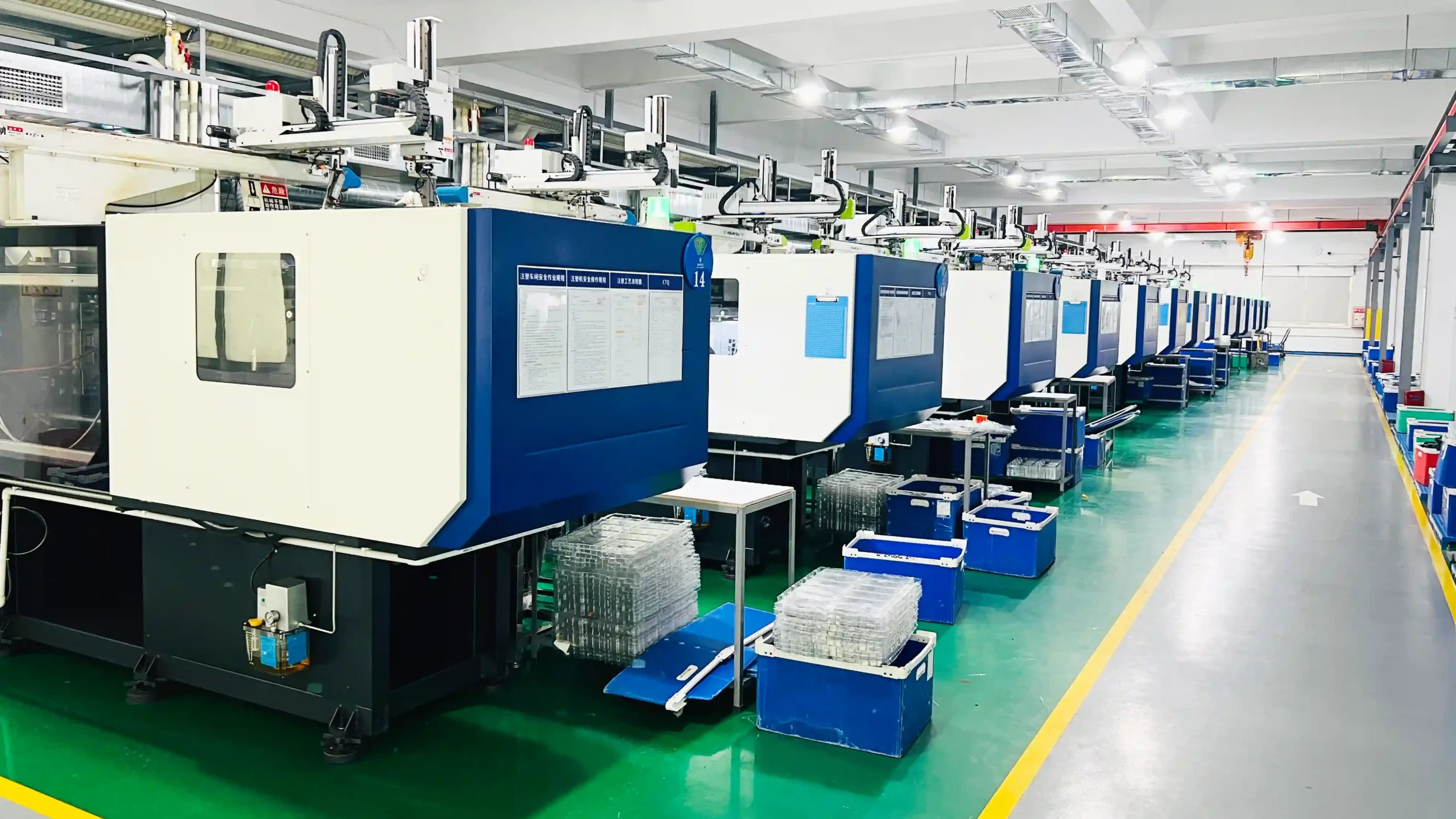
That “thermoplastic” part matters in manufacturing. It means TPU works perfectly with high-speed injection molding — the standard process for mass-producing phone cases. This makes it both practical and cost-efficient at scale.
What Is TPU Material Made Of?
Think of TPU as a two-part system built at the molecular level:
- Hard segments — these give the material its shape, strength, and scratch resistance.
- Soft segments — these give it flexibility, stretch, and the ability to absorb impact.
Together, they create a material that’s tough but not rigid — flexible but not floppy. That balance is what makes TPU so well-suited for phone cases.
In practical terms, a phone case-grade TPU compound typically contains:
- The base TPU resin
- UV stabilizers (to slow down yellowing)
- Colorants or clarity agents (for transparent cases)
- Optional additives like antimicrobial agents or recycled content
Is TPU Hard or Soft?
The honest answer: it depends on the grade.
TPU hardness is measured on the Shore scale. Here’s a simple breakdown:
| Hardness Level | Shore Value | Common Use |
|---|---|---|
| Ultra-soft / gel | Shore A 40–60 | Inner cushion layers |
| Standard flexible | Shore A 80–95 | Most TPU phone cases |
| Semi-rigid | Shore D 40–55 | Hybrid case outer shells |
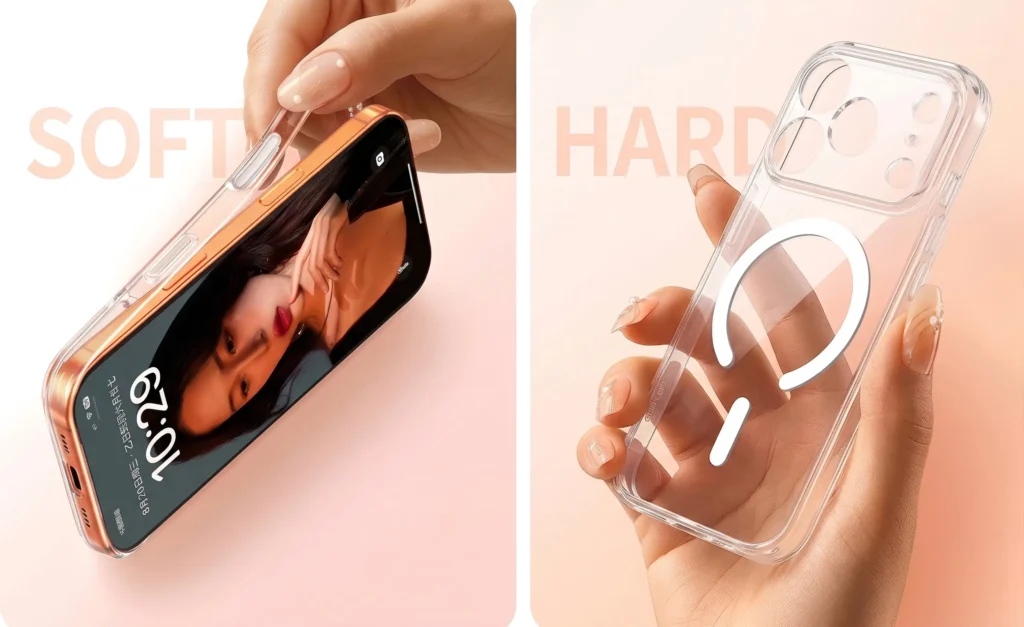
Most standard TPU phone cases sit in the Shore A 80–95 range. In real-world use, this means the case flexes easily when you install or remove it — but holds its shape firmly on the device during everyday use.
Key Features of TPU Phone Case Material
Flexibility and Elasticity
TPU can stretch significantly before it tears — often two to five times its original length. For phone cases, this means:
- Easy snap-on installation without cracking
- Long-term shape retention even after repeated use
- A snug fit that doesn’t loosen over time
As a flexible phone case material, TPU outperforms rigid polycarbonate and feels more structured than silicone.
Shock Absorption & Impact Resistance
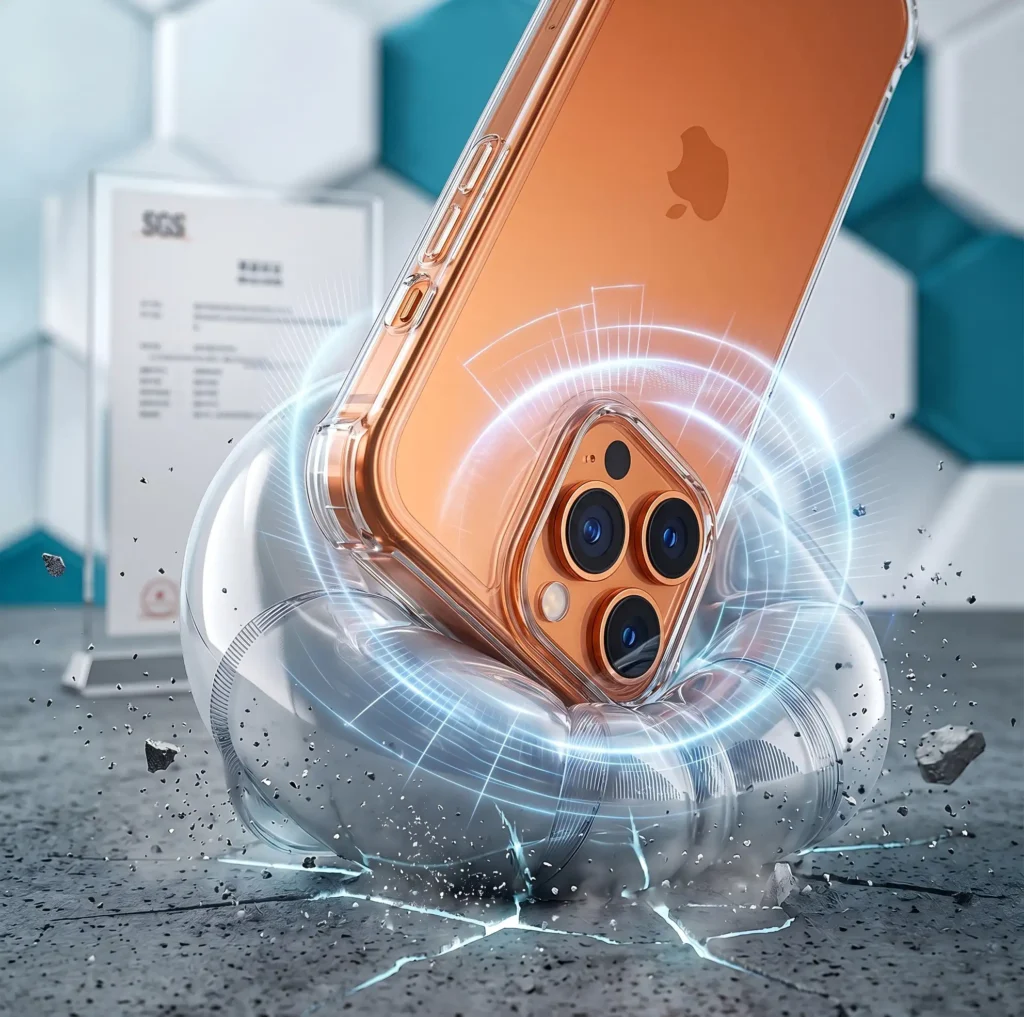
TPU doesn’t just resist impact — it absorbs it. When a phone drops, TPU spreads the force across the case surface instead of letting it hit one point directly. This protects the corners and screen edges — the most vulnerable parts of any device.
This is why so many shockproof phone case designs use TPU as their core protective layer. The impact-absorbing behavior is built into the material itself — not added through a coating or treatment.
Grip, Texture, and User Experience
TPU naturally has more grip than polycarbonate or acrylic. It feels secure in the hand without being sticky.
Beyond that, manufacturers can engineer the surface further — matte finishes, soft-touch coatings, carbon fiber textures — to hit specific feel and aesthetic targets.
For brand owners, this matters. Hand feel directly affects how customers perceive quality, especially in the $15–$40 retail price range, where most branded TPU cases compete.
Durability and Abrasion Resistance
TPU holds up well against everyday wear — keys in a pocket, rough surfaces, daily contact. It resists micro-scratches better than silicone, which tends to scuff and collect debris.
For brands that promise a scratch-resistant phone case, TPU delivers that performance reliably over a product’s full lifecycle.
Advantages of TPU Phone Cases
Lightweight and Slim Profile
TPU can be molded as thin as 0.8–1.2mm without losing structural integrity. This allows for slim, lightweight cases that add minimal bulk to the device.
For consumers carrying today’s larger flagship phones, slim protection is a key purchase driver — and brands that deliver it hold a real market advantage.
Cost-Effective for Mass Production
TPU sits in a smart pricing position. It costs more than basic commodity plastics — but far less than premium silicone, leather, or metal. And it outperforms most of those materials on drop protection at the same price tier.
From a production standpoint, TPU injection cycles run 25–45 seconds per shot. Multi-cavity tooling (4-cavity, 8-cavity) is standard at scale. The result: unit costs drop sharply as volume increases — a key advantage for wholesale buyers and private label brands working on tight margins.
Compatibility with Customization (OEM/ODM)
TPU supports almost every customization process without compromising the case structure:
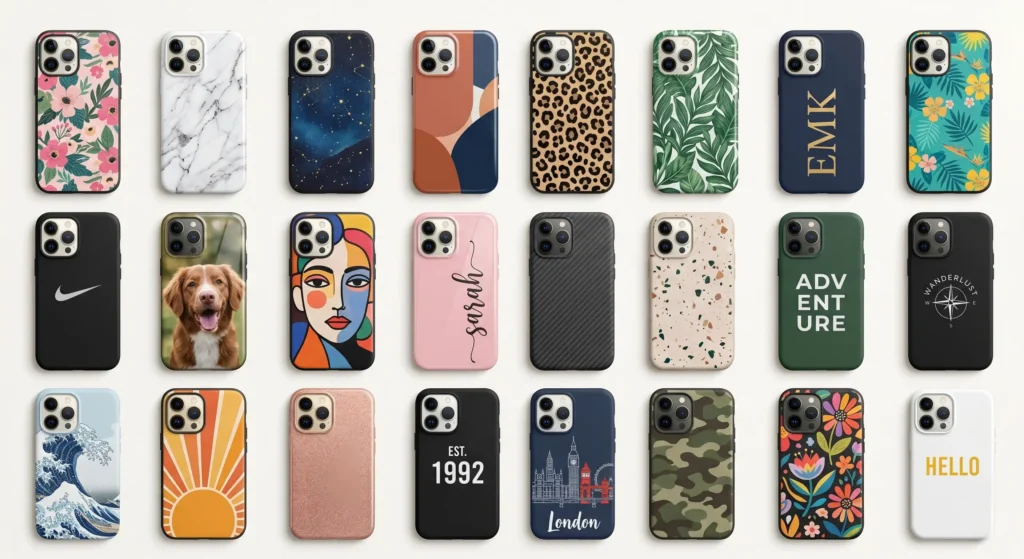
- UV printing — full-color photographic graphics on the case surface
- In-mold decoration (IMD) — graphics bonded during molding for maximum durability
- Electroplating — metallic finishes for premium aesthetics
- Pantone color matching — brand-accurate colors mixed at the material stage
- Logo debossing/embossing — clean branded details on the case surface
For private label phone case programs, this means one base mold can serve multiple SKUs across different visual identities — saving significantly on tooling costs.
Ideal for Hybrid (Dual-Layer) Case Structures
Here’s something most buyers overlook: TPU is the ideal inner layer in dual-layer shockproof cases.
In hybrid designs — TPU inner shell + PC outer shell — the TPU handles energy absorption while the polycarbonate provides structural rigidity and a clean surface finish. This combination is how brands achieve military-grade drop protection while keeping the case slim and premium-looking.
If you’re developing shockproof SKUs or entering the rugged case segment, understanding this architecture is essential.
Disadvantages of TPU Cases
Yellowing Over Time (UV Degradation)
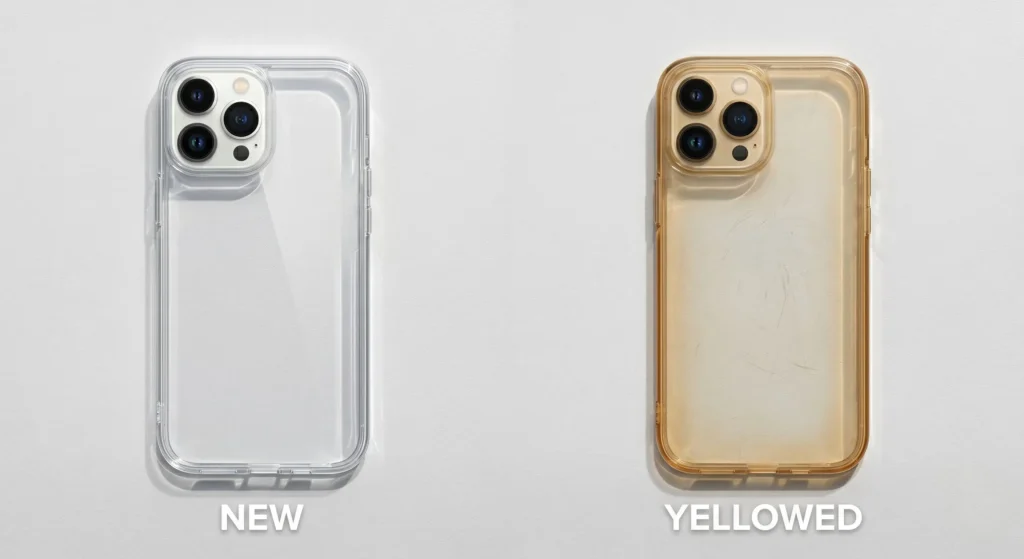
This is the most common quality complaint in the clear TPU phone case category. Standard transparent TPU turns yellow within 3–6 months of normal use, caused by sun exposure breaking down the material over time.
The good news: it’s preventable. Quality manufacturers address phone case yellowing through:
- UV stabilizer additives are blended into the compound during production
- Anti-yellow topcoat applied as a post-process finish
- Yellowing-resistant TPU grades (often marketed as “crystal” or “diamond” TPU) formulated specifically for optical clarity
When sourcing clear cases, always ask suppliers for anti-yellowing test data — typically a UV chamber exposure test run at 80°C for 48–72 hours. If a supplier can’t provide it, that’s a red flag.
Lower Structural Rigidity vs. PC
TPU is not the right choice when a case design requires high rigidity. Applications like snap-fit mechanisms, rigid kickstands, or large flat panels that must stay perfectly flat are better served by polycarbonate.
In a TPU vs. PC phone case comparison, PC wins on rigidity and surface hardness; TPU wins on impact absorption and flexibility. The best solution for high-performance cases is usually both — a hybrid design that uses each material where it performs best.
Oil Absorption and Aging Issues
Over time, softer TPU grades can develop a slightly tacky surface feel as the case ages and absorbs skin oils. This is a natural material characteristic — not a manufacturing defect — but it affects how consumers perceive long-term quality.
To minimize this, specify a higher Shore hardness (Shore A 90+), apply a matte or UV-cured topcoat, or select a TPU grade formulated with better resistance to moisture and aging.
TPU vs. Other Phone Case Materials
TPU vs. Silicone Phone Case
| Property | TPU | Silicone |
|---|---|---|
| Flexibility | High | Very High |
| Scratch Resistance | Good | Poor |
| Transparency | Achievable | Limited |
| Cost | Lower | Higher |
| Yellowing Risk | Yes (clear grades) | Low |
| Customization | Extensive | Limited |
In the TPU vs. silicone case debate, it comes down to application. Silicone excels in softness and temperature resistance. TPU wins on printability, clarity, scratch resistance, and cost-efficiency — which is why it dominates the consumer electronics case market.
TPU vs. Polycarbonate (PC)
Neither material is universally better — they serve different roles.
PC offers optical clarity, rigidity, and scratch hardness. TPU offers impact absorption, flexibility, and grip. As standalone materials, each has clear limitations. As a combined polycarbonate TPU hybrid, they produce the best all-around protective case available at mass-market price points.
TPU vs. Acrylic, Leather, and Metal Cases
- Acrylic — excellent clarity, but brittle. Best used as a decorative inset panel, not a structural case.
- Leather — premium aesthetics, minimal drop protection. Better for folios and sleeves than form-fitting protective cases.
- Metal (aluminum alloy) — maximum rigidity and premium feel, but heavy, expensive, and it can interfere with wireless signals.
For brands that need protective performance, design flexibility, and competitive unit economics in a single material, TPU remains the clear frontrunner.
How TPU Phone Cases Are Manufactured
Injection Molding Process Explained
Every standard TPU phone case starts the same way: injection molding. Here’s the process in plain terms:
- TPU pellets are dried to remove moisture (critical for part quality)
- The pellets are melted at 180–220°C inside the molding machine
- Molten TPU is injected under pressure into a hardened steel mold
- The mold holds the shape while the material cools (15–30 seconds)
- The finished case is ejected, trimmed, and inspected
What separates a precision manufacturer from a commodity supplier is the engineering behind the mold — gate placement, cooling channel design, and ejection mechanics. These details determine whether every case in a production run meets your dimensional spec or whether you’re dealing with inconsistent quality at the warehouse.
Material Grades: Virgin vs. Recycled TPU
This is a procurement decision with real business implications:
- Virgin TPU — consistent performance, full traceability, suitable for clear or color-matched cases, meets EU/FDA compliance requirements
- Recycled TPU (rTPU) — typically 15–25% lower cost, with some limitations on color options and mechanical consistency. Well-suited for sustainability-positioned product lines
If your brand is building an eco-friendly line or responding to ESG requirements, recycled TPU is a credible option. Just make sure your supplier provides recycled content certificates and physical test data — not just a “recycled material” claim on a spec sheet.
Quality Control in TPU Case Production
A professional manufacturer should have checkpoints throughout the production process — not just at the end. These include:
- Incoming material inspection — hardness verification, moisture content testing
- First-article inspection (FAI) — dimensional check against CAD tolerances (typically ±0.1–0.2mm)
- In-process inspection — surface defect audit, wall thickness measurement
- Drop testing — 1.2m–1.5m drop onto concrete, 8-face protocol
- Outgoing QC — AQL sampling per ANSI/ASQ Z1.4 Level II, functional device fit check
Ask for QC documentation during supplier qualification. For new suppliers, an on-site audit before committing to volume is strongly recommended.
Applications of TPU in Phone Case Design
Clear TPU Phone Cases
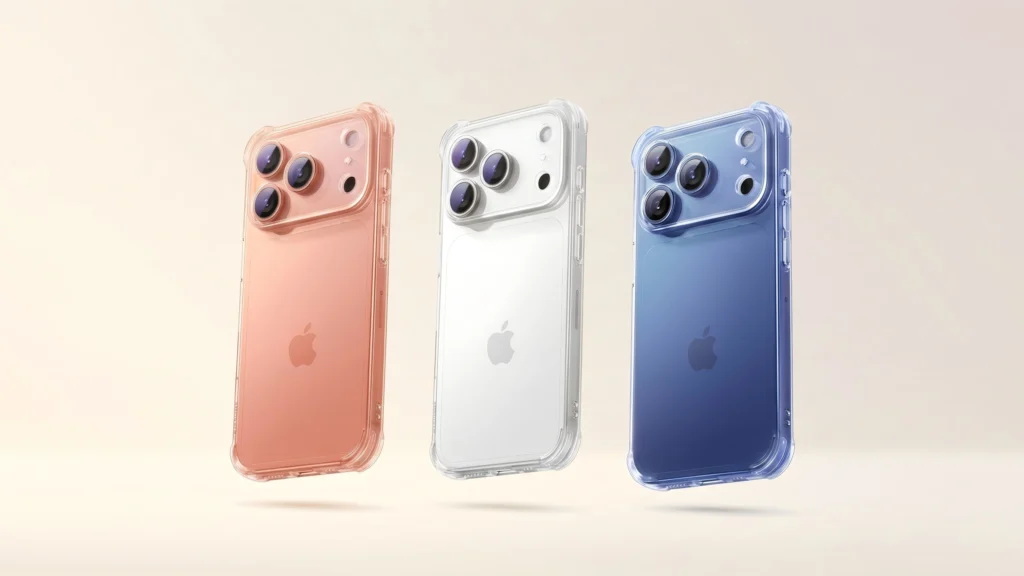
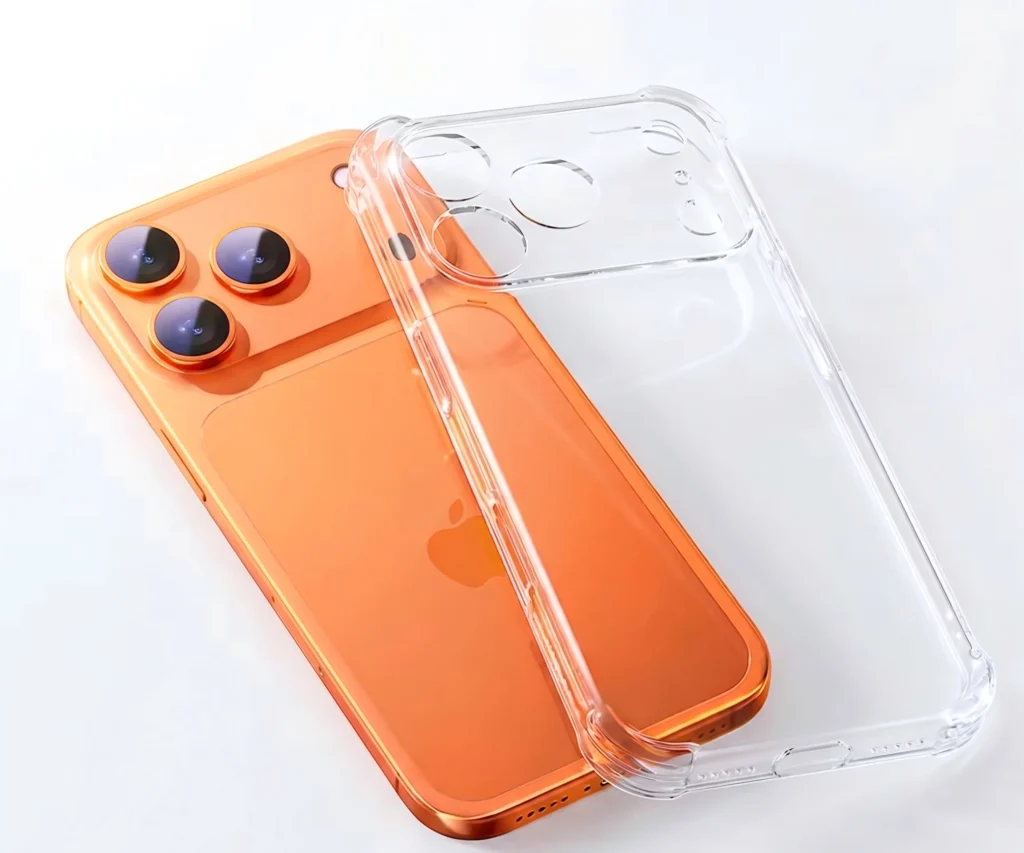
Clear TPU phone cases are one of the highest-volume SKUs globally. They let consumers show off their device design while still providing everyday drop and scratch protection.
The main challenge is yellowing — addressed through UV-stabilized compounds and anti-yellow coatings. For brands, clear cases carry strong consistent demand and lower design costs since there’s no color tooling required.
Soft TPU Cases vs. Hybrid Cases
Soft TPU cases (Shore A 60–80) prioritize grip and cushion feel. They’re popular in lifestyle and fashion-brand case lines where the tactile experience matters as much as the protection spec.
Hybrid cases pair a soft TPU inner layer with a rigid PC or acrylic outer shell. They target the rugged and shockproof segment — where brands need to meet drop-certification standards while maintaining a premium appearance.
Your choice between these two architectures should be based on your target retail price point, certification requirements, and brand positioning.
TPU as Inner Layer in Shockproof Cases
The highest-performing protective cases — including those certified to military-grade drop standards — rely on TPU as the energy-absorbing inner layer.
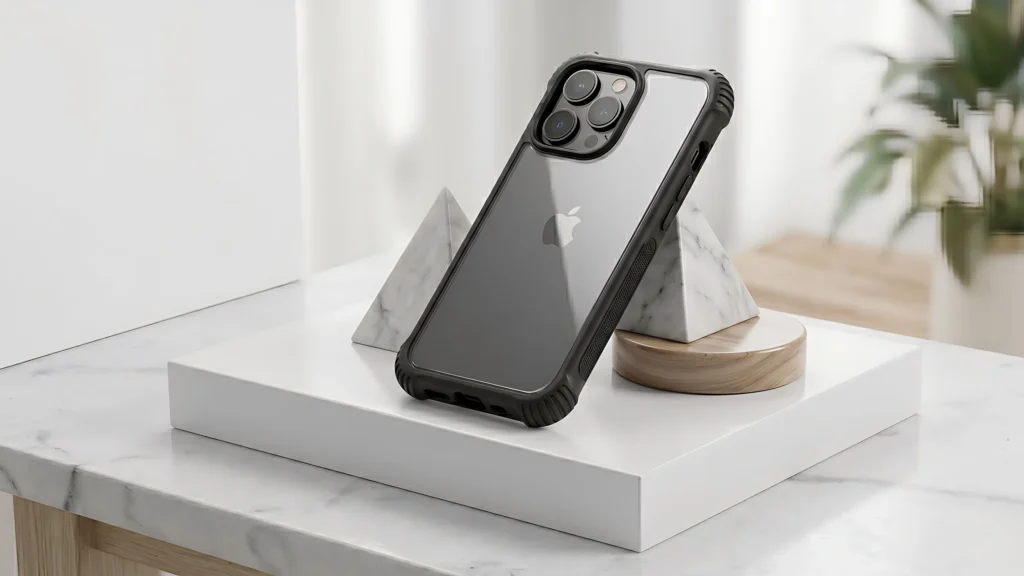
In these designs, TPU is often molded with corner air pockets or internal ribbed structures that amplify impact dissipation. This architecture is behind the majority of premium shockproof phone cases on the market. If your brand competes in the protective case segment, this is the design logic your supplier should understand fluently.
Are TPU Phone Cases Safe and Eco-Friendly?
BPA-Free and Non-Toxic Properties
TPU is BPA-free by nature — the chemical structure doesn’t use bisphenol A at any point in production. It’s widely used in medical devices, food-contact films, and sports equipment — all categories with strict safety standards.
For consumer phone cases, TPU poses no known toxicity concerns under normal use. Brands targeting health-conscious consumers can call this out confidently.
REACH & RoHS Compliance (For EU Buyers)
If you’re selling into European markets, compliance documentation is non-negotiable. Your supplier should be able to provide:
- REACH compliance report — confirming no restricted substances above 0.1% w/w
- RoHS compliance report — restricting hazardous substances (lead, cadmium, certain flame retardants) to below regulatory limits
- California Prop 65 — required for the US market, especially relevant for cases with coatings or colorants
Third-party test reports from SGS, Intertek, or Bureau Veritas are the standard. If a supplier can’t produce these on request, treat it as a disqualifying factor — not a minor paperwork issue.
Recyclability and Sustainability
TPU is a thermoplastic, which means it can theoretically be remelted and reprocessed. In practice, post-consumer recycling infrastructure for phone cases is still limited.
The most actionable sustainability pathways for brands today are:
- Specifying recycled TPU content in your production material
- Joining or creating product take-back programs for end-of-life cases
- Exploring bio-based TPU grades derived partly from renewable feedstocks
As sustainability requirements tighten across US and European markets, build this into your supplier contracts now — not as an afterthought.
How to Choose the Right TPU Phone Case Supplier
Key Factors for Wholesale Buyers
When evaluating a wholesale phone case manufacturer, look beyond price per unit. These are the factors that determine long-term reliability:
- In-house tooling — suppliers who own their mold shop control revision speed and protect your design IP
- Verified resin sourcing — look for suppliers using tier-1 TPU resin brands (Covestro, BASF, Huntsman)
- Compliance infrastructure — can they produce REACH, RoHS, and Prop 65 reports proactively?
- Customization scope — do they handle printing, coating, and packaging in-house, or do they outsource them?
- Production capacity — do they have headroom to scale during peak season without delays?
MOQ, Pricing, and Lead Time
Here are the typical benchmarks for TPU phone case procurement:
| Parameter | Standard Range |
|---|---|
| MOQ (per style/color) | 300 – 1,000 units |
| Sample lead time | 7 – 15 days |
| Mass production lead time | 20 – 35 days |
| Unit price (standard TPU) | $0.80 – $2.50 (volume-dependent) |
| Tooling cost | $300 – $800 per mold |
Pricing varies based on design complexity, coating type, and the scope of customization. Always benchmark across at least three qualified suppliers before finalizing your sourcing decision.
Customization Capabilities
A strong OEM phone case supplier for private label programs should offer:
- Custom color matching (Pantone reference)
- Logo integration — debossed, embossed, printed, or inlaid
- Custom retail packaging — boxes, polybags, hang tags
- Compliance labeling and branded documentation
- NDA and tooling ownership agreements to protect your designs
FAQ
Are TPU cases protective?
Yes. TPU is one of the most effective everyday protective materials available. It absorbs and spreads impact energy during drops, reducing the force that reaches the device. In dual-layer shockproof designs, TPU serves as the primary energy-absorbing component.
Is TPU better than silicone?
For most phone case applications, yes. TPU offers better scratch resistance, greater design flexibility (transparency, printing, textures), lower production cost, and comparable drop protection. Silicone has advantages in extreme softness and heat resistance — but those properties are rarely the priority in consumer phone case design.
Why do TPU cases turn yellow?
Yellowing happens when UV light from sun exposure gradually breaks down the TPU material over time. It mainly affects clear and light-colored grades. The solution: UV-stabilized compound formulations, anti-yellowing topcoats, or yellowing-resistant TPU grades designed specifically for optical clarity.
Are TPU phone cases good for bulk orders?
Yes — TPU is the go-to material for bulk phone case production. It’s fully compatible with high-speed injection molding, multi-cavity tooling, and broad customization workflows. Unit economics improve significantly above 1,000 units per SKU, making it ideal for wholesale, private label, and OEM programs.