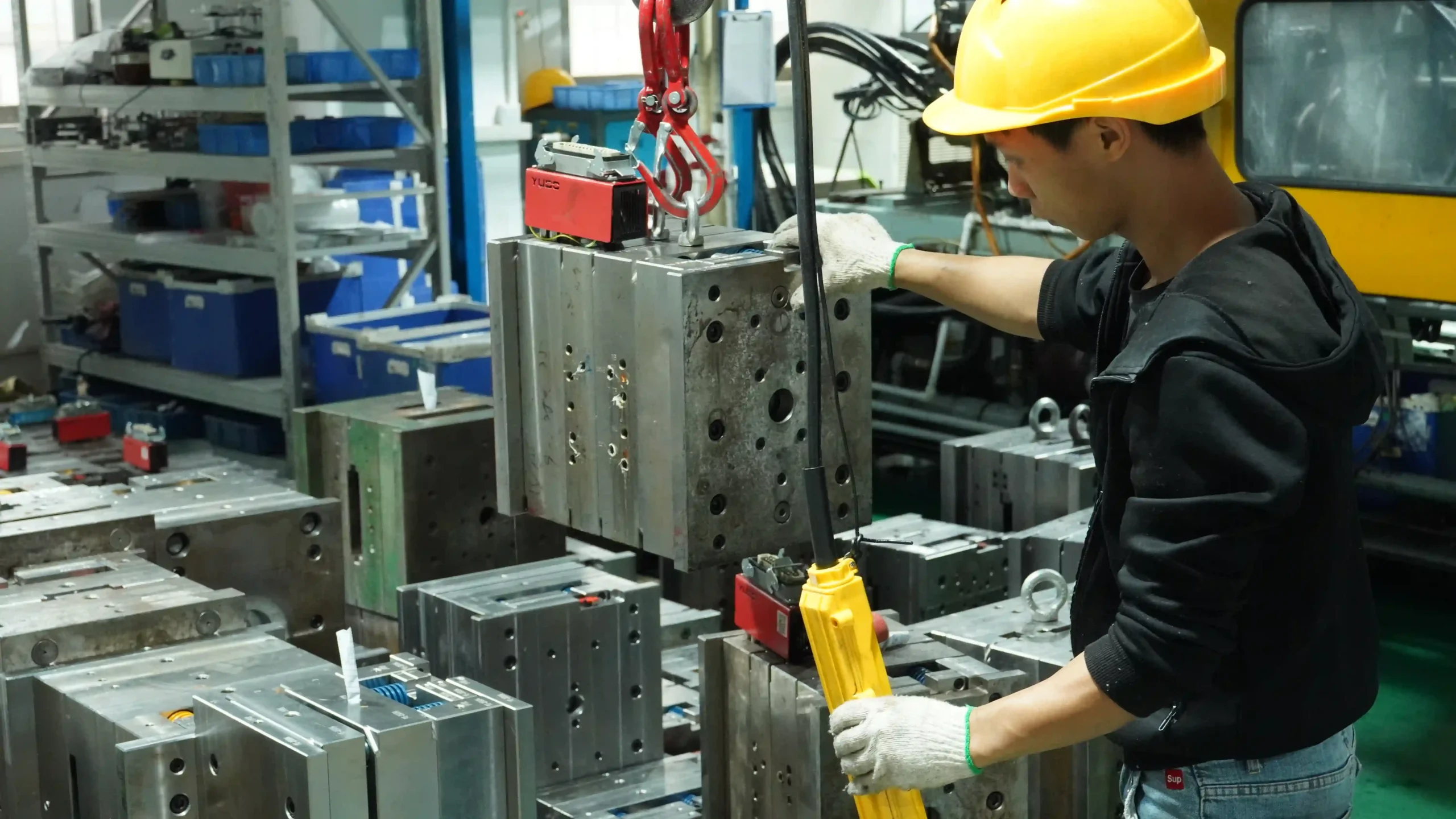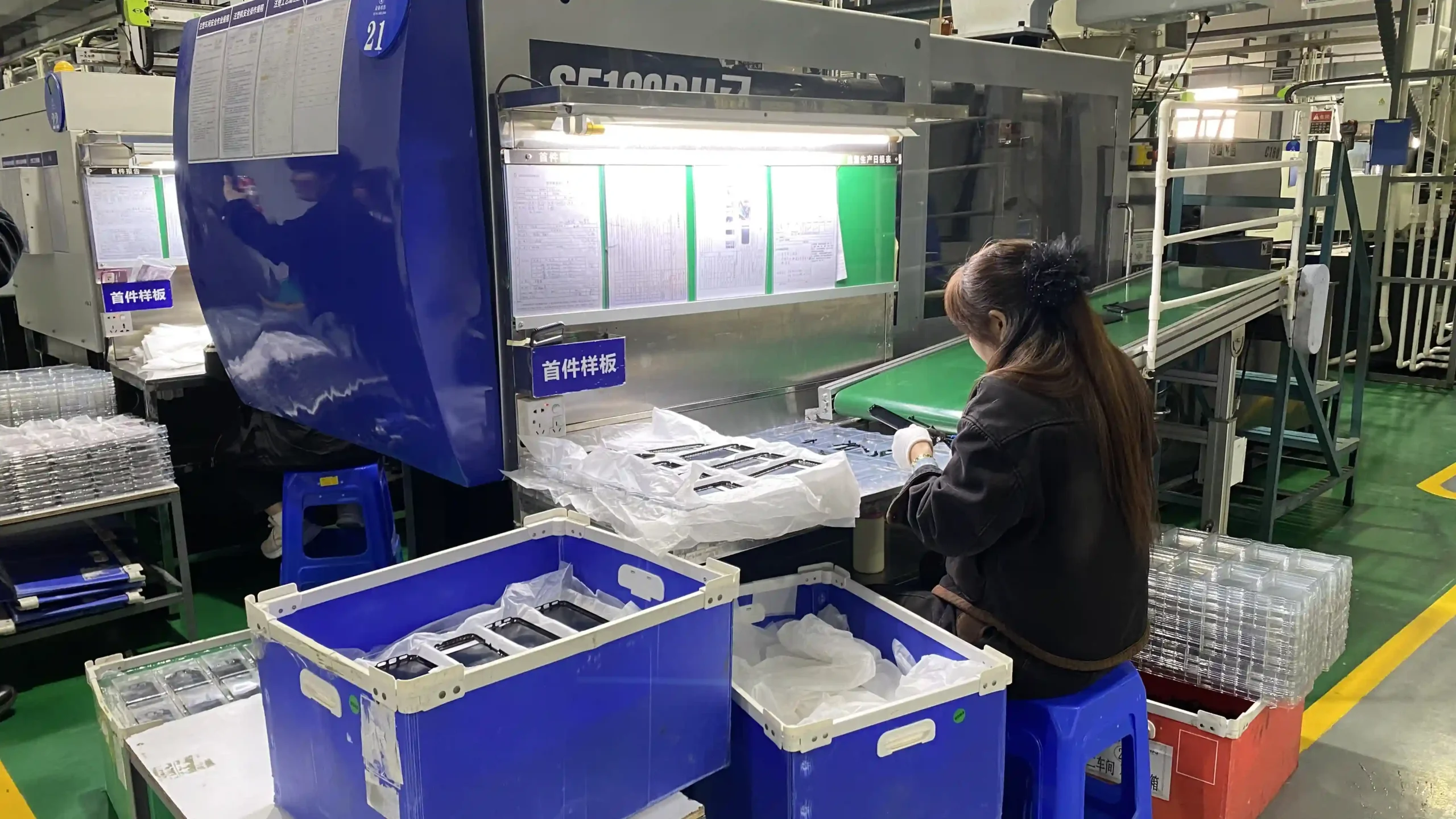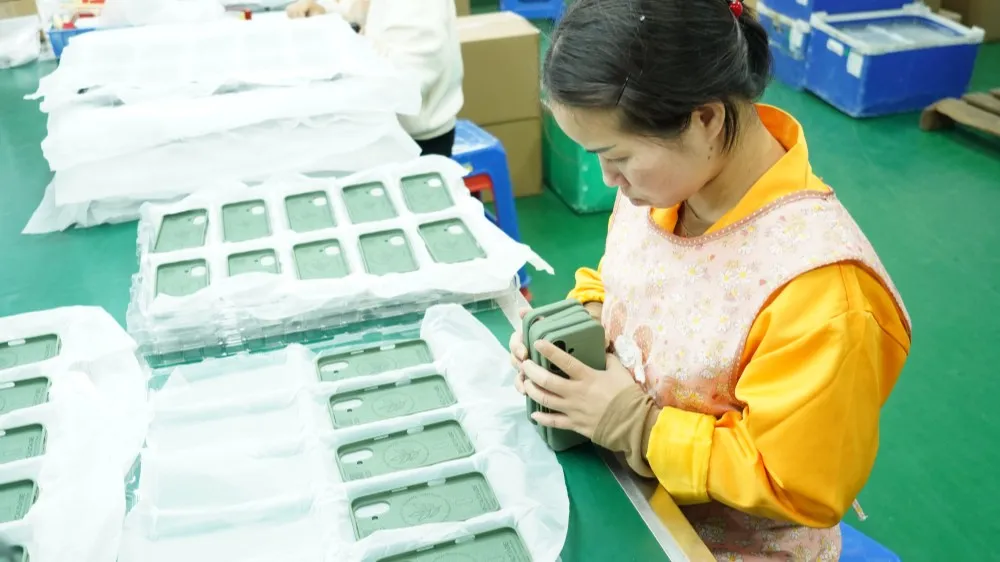
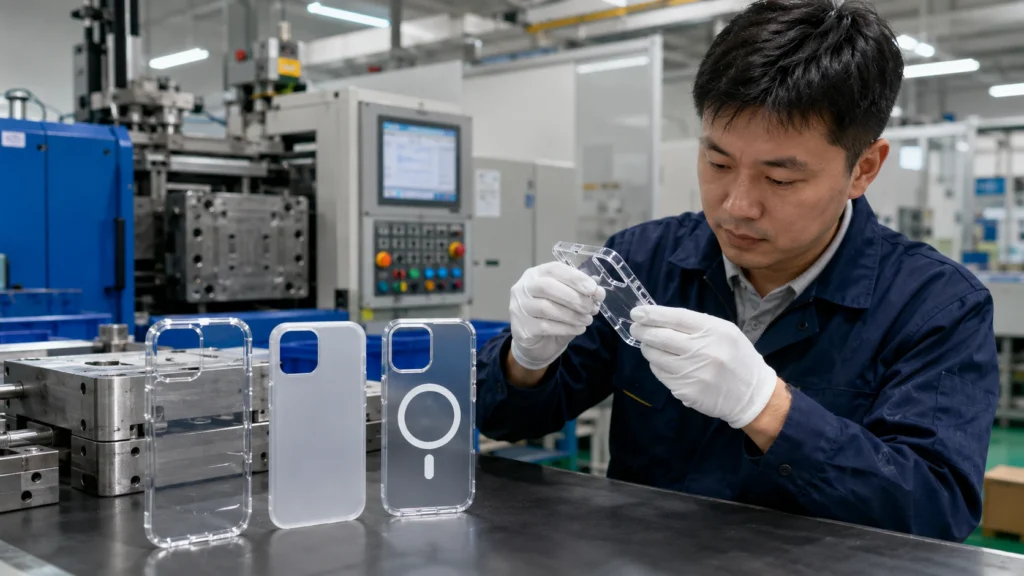
A freshly molded phone case is rarely a finished product. While precision in injection molding is critical, it often represents just the first step in the manufacturing cycle.
To meet the rigorous standards of global retail, raw plastic parts generally require secondary operations. This makes injection molding post processing an essential part of production.
This guide breaks down the core techniques used in custom phone case manufacturing. We will cover everything from structural cleanup to surface finishes and advanced assembly.
What is the Post Mould Process?
Table of Contents
ToggleCustom phone case production doesn’t end with injection molding. Post-mold work covers all physical and chemical secondary processes carried out after parts are ejected from molds, converting blank casings into fully finished products.
The Plastics Injection Molding Process and Secondary Operations
To understand why these steps are needed, look at what the injection moulding process is at its core. The plastics injection molding process is precise, but parts are typically affected by parting lines, gate placement, and natural material shrinkage.
Because of this, freshly molded cases frequently have excess flash and a basic surface texture. They may also lack the tight dimensional tolerances required for complex, multi-material assemblies.
Secondary operations effectively address these physical limitations. These techniques are widely used to refine case aesthetics, achieve precise component fits, and support reliable assembly.
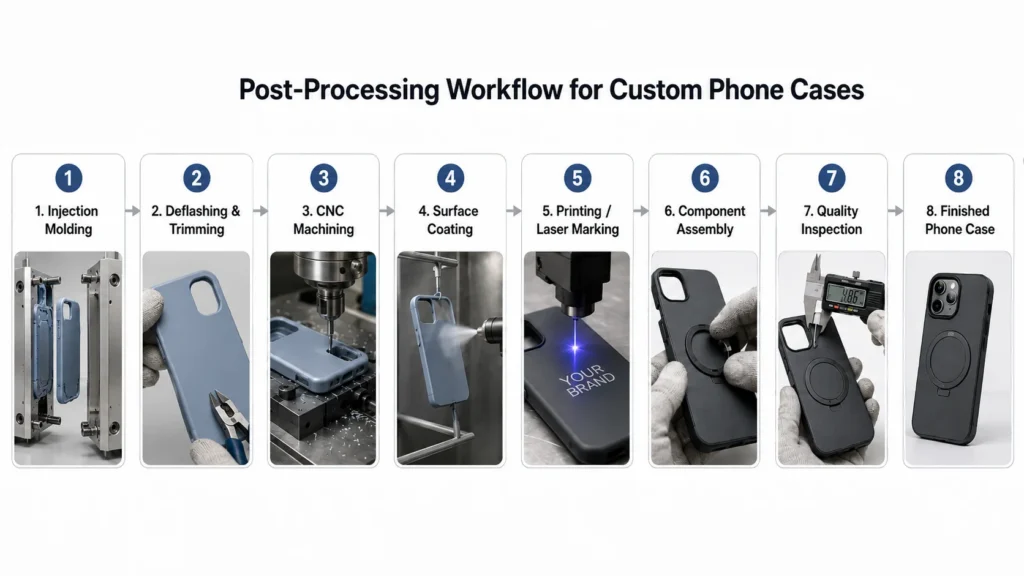
Core Injection Molding Post Processing Techniques for Phone Cases
Once your cases leave the mold, appropriate injection molding processing techniques help refine them. The methods chosen depend heavily on your material and final design goals. Let’s look at the key operations for phone case manufacturing.
| post processing | Category | Primary Function | Common Phone Case Applications |
| Deflashing & Trimming | Structural Cleanup | Removes excess flash and gate vestiges. | Smoothing side parting lines; flattening bottom gates for assembly. |
| CNC Machining | Precision Subtractive | Achieves tight tolerances and complex geometries. | Cutting dense speaker arrays; milling high-gloss edges; engraving 3D logos. |
| Surface Coatings | Aesthetic & Protective | Alters tactile feel, appearance, and durability. | Soft-touch rubber feel; UV anti-yellowing for clear cases; NCVM metallic frames. |
| Pad Printing & Laser Marking | 2D Graphics | Adds durable colors, logos, and compliance text. | Localized color accents on curves; wear-resistant brand logos; inside CE/FCC certifications. |
| Ultrasonic Welding | Glue-Free Assembly | Fuses plastic components via high-frequency friction. | Integrating camera bezels, encapsulating MagSafe rings, and assembling multi-part heavy-duty cases. |
Deflashing and Trimming
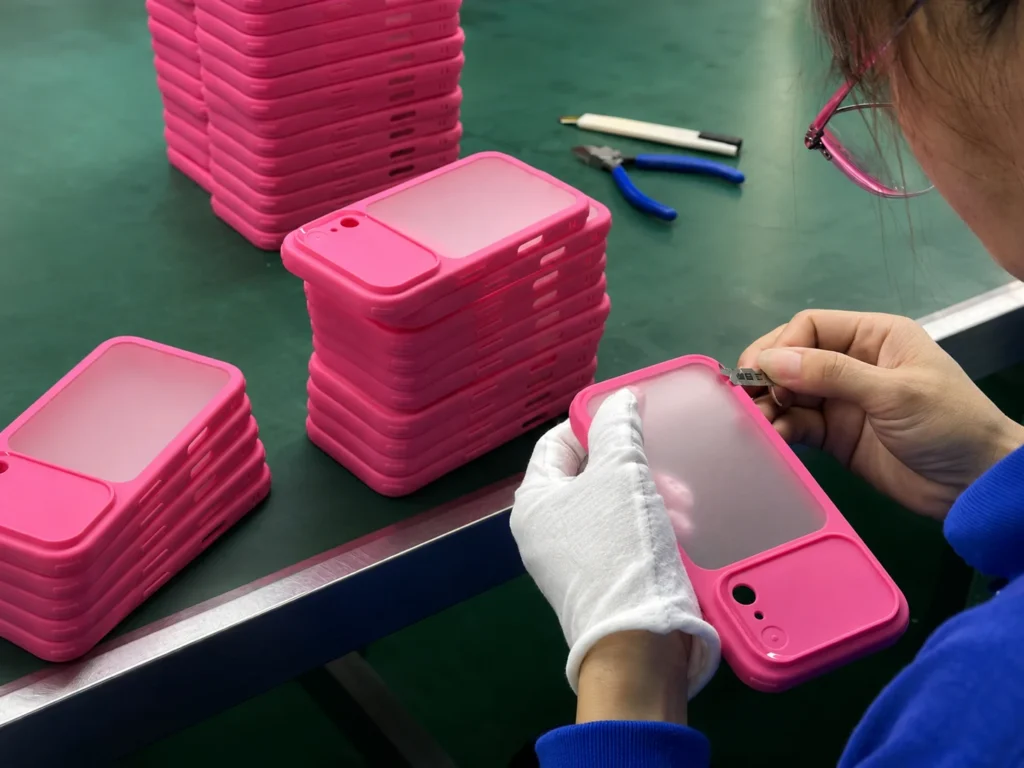
Flash and gate vestiges are highly common in custom injection molding. To remove this excess material, manufacturers rely on physical deflashing and trimming, often using manual cutting, mechanical sanding, or automated tooling.
For flexible materials like TPU or silicone, cryogenic deflashing is highly effective. This technique uses liquid nitrogen to freeze the soft flash, making it brittle so it can be tumbled off without damaging the main body.
The primary goal of trimming is to smooth parting lines along the sides of your phone cases. This promotes an ergonomic grip and flattens gate vestiges to prepare the surface for secondary coatings or multi-part assembly.
CNC Machining
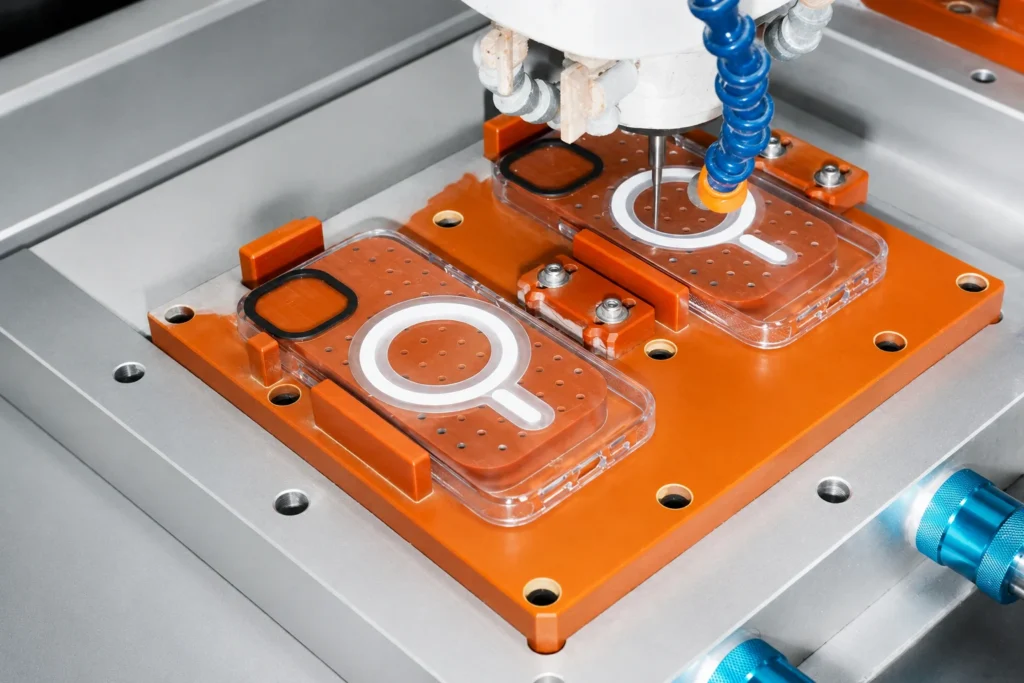
While injection molds form the basic shape, CNC machining is essential for processing plastics with extreme precision (±0.03mm). It is strictly used to cut critical functional openings, such as camera holes, charging ports, side buttons, and dense speaker arrays, ensuring perfectly straight and burr-free walls.
Beyond functional cuts, CNC is a powerful aesthetic tool for premium cases. By using high-speed diamond cutters, manufacturers can mill chamfers and high-gloss mirror edges around the PC frame or camera ring. This physically cuts a shiny, premium edge that laser marking cannot replicate.
Additionally, CNC tools handle complex structural grooves and tactile textures. It is the standard method for milling precise blind grooves to embed MagSafe rings, cutting decorative backplate lines, and engraving 3D logos that are far more durable than printed graphics.
Surface Finishes and Coatings
Raw plastic often lacks the premium feel your customers expect. Quality plastic injection molding services provide various surface finishes to alter the tactile feel, add protective layers, or significantly enhance the physical appearance.
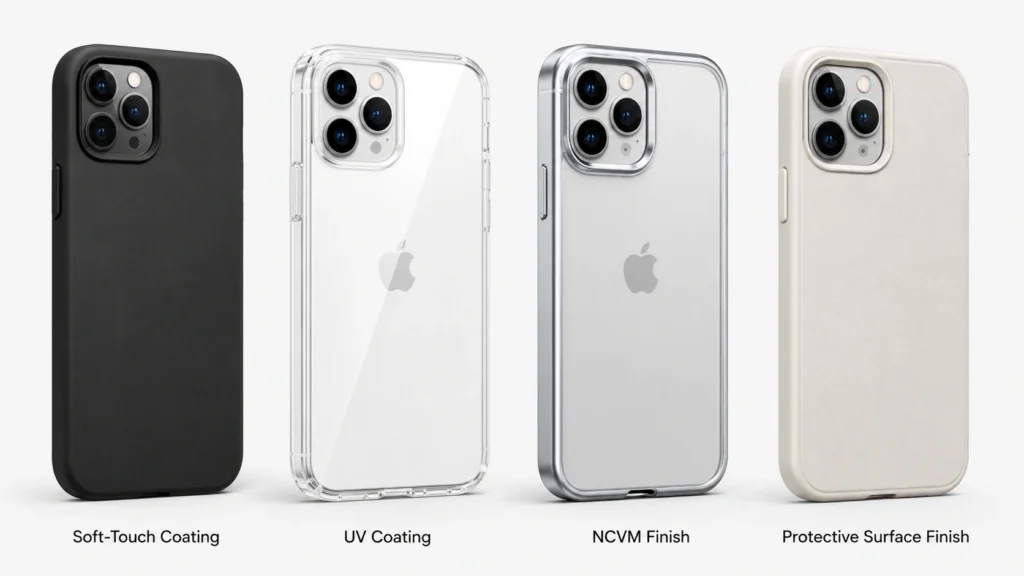
Soft-touch coating is highly popular for hard PC phone cases, giving rigid plastic a premium, rubber-like feel. For clear phone cases, a UV coating is strongly recommended to increase surface hardness and resist long-term yellowing.
For high-contact environments, anti-microbial coatings using silver ions can help inhibit bacterial growth. Additionally, Non-Conductive Vacuum Metallization (NCVM) gives plastic frames a realistic metallic shine without blocking cellular signals.
Pad Printing and Laser Marking
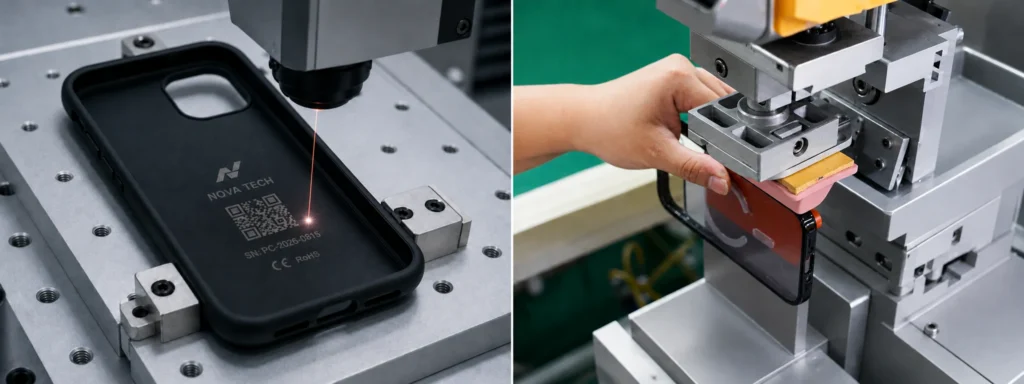
Pad printing and laser marking are standard methods for adding 2D graphics to phone cases. Pad printing uses a flexible silicone pad to transfer ink, adapting well to small areas on curved or uneven surfaces. Laser marking uses a focused beam to create a high-contrast mark.
Instead of large-area patterns, pad printing is frequently used for applying precise, localized graphics like small brand icons or specific color accents. It works effectively around complex contours, such as case edges or raised camera bumps.
Laser marking is commonly used for applying durable brand logos that resist daily wear. It is also a standard choice for engraving safety certifications, product serial numbers, and QR codes inside the housing.
Assembly
When assembling multi-part phone cases, relying solely on traditional adhesives can sometimes lead to bonding issues. Instead, glue-free assembly techniques like ultrasonic welding and heat staking offer strong, solid-state connections.
This technology is valuable for integrating functional components. You can ultrasonically weld independent camera bezels onto the main housing while minimizing the risk of glue overflow. It is also a standard method for encapsulating MagSafe modules.
Advanced assembly techniques also support structural durability. They are widely used to fuse complex heavy-duty cases, hidden back kickstands, or lanyard attachments, helping them withstand daily mechanical stress.
Injection molding design rules for cost optimization
One of the most effective ways to control production costs is during the design phase. By following recommended injection molding design rules, you can significantly reduce the need for excessive post-processing.
Smart Design for Manufacturability (DFM) strategically positions unavoidable mold marks. Designing parting lines to fall within non-contact decorative grooves keeps them away from the grip. Similarly, positioning gates in hidden internal areas minimizes the need for careful cosmetic trimming.
These engineering decisions provide direct financial benefits. Reducing reliance on secondary CNC machining and manual deflashing cuts down labor and machine time, often resulting in more competitive injection molding quotes for OEM projects.
Strict injection molding quality control
The value of post-processing relies heavily on the reliability of the final product. To achieve this, quality-focused manufacturers typically implement strict injection molding quality control protocols after secondary operations.
Surface finishes generally need to pass objective durability evaluations before leaving the factory. Teams often use the cross-cut test to check coating adhesion and the RCA paper test to evaluate abrasion resistance. Tensile testing can also confirm the bond strength of welded components.
Finished parts are expected to meet global injection molding standards for dimensional accuracy. Real-device assembly tests are frequently used to verify that secondary machining or welding heat did not cause significant material deformation.
Moving Forward with Your Project
Mastering injection molding post processing is a proven path to turning raw plastic into premium phone cases. It requires a balanced combination of structural machining, aesthetic coatings, and organized quality control.
Partnering with a phone case manufacturer experienced in both tooling and secondary operations helps maintain consistent quality. At YG Cases, we focus strictly on custom molding and OEM/ODM solutions for mobile accessories.
Contact us today by sending your 3D CAD files. We are ready to provide a DFM review and production quote to help get your project started.